
When a pipeline produces an unexpected result, the first questions are usually simple: Which data did it read? Which code ran? What parameters were used? If the answers are scattered across logs, shell history, and mutable object paths, reproducing the run becomes guesswork.
A reproducible pipeline makes each run identifiable and records enough information to explain how its outputs were produced. It does not mean every distributed job will produce byte-for-byte identical output on every machine. It means the inputs, execution context, assumptions, and validation results are explicit enough to rerun, compare, and investigate the work.
Define what a run means
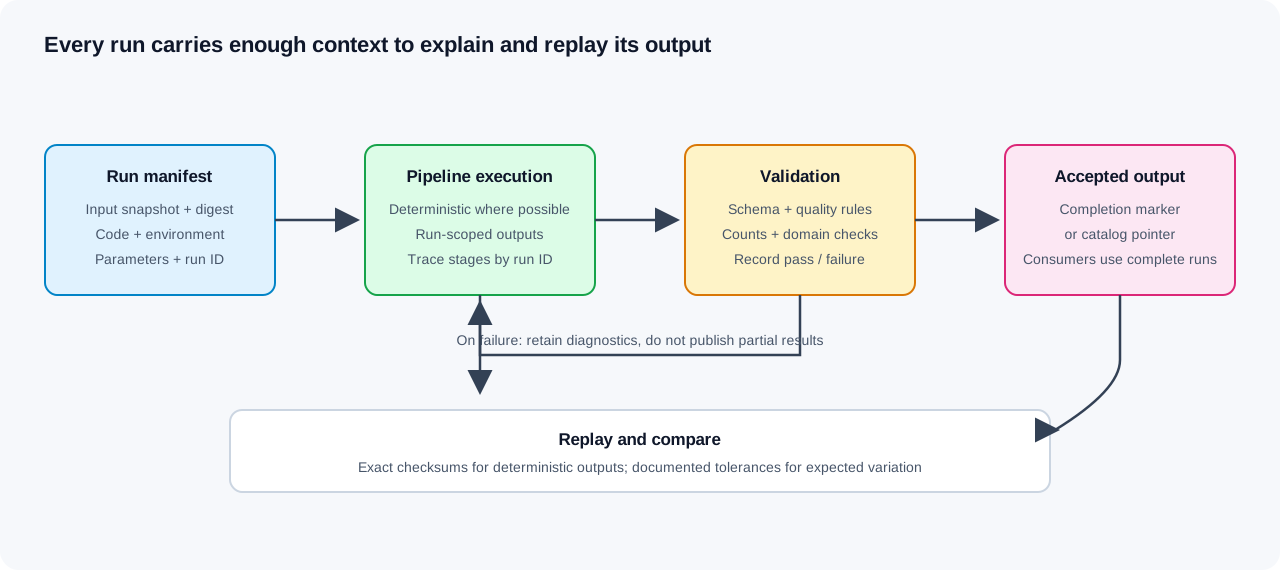
Give every execution a unique run ID and create a manifest for it. At minimum, record:
- Inputs: dataset identifiers, object versions or immutable snapshot references, extraction window, and a checksum or content digest where appropriate.
- Code: repository URL, commit ID, and any uncommitted-change indicator for locally launched runs.
- Environment: runtime version, dependency lockfile or image digest, and relevant system configuration.
- Parameters: explicit values, configuration version, random seeds, and feature or model settings.
- Outputs: locations, schema versions, record counts, and checksums when useful.
- Validation: quality checks, warnings, metrics, and whether the run was accepted for downstream use.
- Lineage: parent run or source references and the stage that produced each output.
Do not place passwords, access tokens, or sensitive row-level data in a manifest. Store secret references or secret-manager version identifiers where needed, and apply the same access controls to metadata as to the data it describes.
Make inputs immutable or precisely addressable
A path such as s3://analytics/raw/latest/ is convenient but ambiguous if objects beneath it can change. A later rerun may read a different set of files and appear to reproduce the original job when it did not.
Prefer immutable object versions, dated snapshots, content-addressed datasets, or a manifest that lists the exact input objects and versions. Object versioning can help recover previous object states, but a pipeline still needs to record which version it consumed. For databases, record the extraction window, query or snapshot identifier, and relevant source watermark so the same logical input can be identified later.
Data retention, privacy rules, and deletion obligations still apply. Reproducibility is not a reason to retain personal or regulated data indefinitely; define retention and access policies for snapshots and manifests.
Pin the execution environment
Recording requirements.txt is useful, but a loose range of dependency versions may resolve differently months later. Use a lockfile or a versioned container image, and record its exact revision or digest for each run. Also record the language and runtime versions.
Pinning improves repeatability but does not guarantee identical numeric output in every environment. Parallel reductions, hardware-specific kernels, nondeterministic algorithms, and external services can introduce variation. Set random seeds where supported, document known nondeterminism, and define acceptable tolerances for numeric outputs.
Make reruns safe
Retries are normal in distributed systems; duplicate side effects should not be. Design each stage so a retry is either idempotent or uses a unique run-scoped output location. Do not let a failed retry silently overwrite a previously accepted result.
A practical publication pattern is:
- Write intermediate and final candidates under a unique run ID.
- Validate schema, row counts, required fields, and domain-specific checks.
- Write the completed manifest and mark the run as successful only after validation passes.
- Update a small catalog entry or pointer to designate the accepted output.
- Keep failed runs available for diagnosis under a retention policy, without making them look like current production data.
Object stores do not generally provide a multi-object transaction. Instead of assuming a folder rename is atomic, publish a completion marker or catalog pointer only after all expected objects and metadata are present. Consumers should read only outputs associated with a completed run.
Example run manifest
The exact schema will depend on your platform, but a small JSON record can make the essential provenance visible:
{
  "run_id": "2026-10-06T143000Z-8f31",
  "pipeline": "daily-orders-v2",
  "code": {
    "repository": "https://example.invalid/data-platform",
    "commit": "8f31c12"
  },
  "environment": {
    "image_digest": "sha256:replace-with-real-image-digest",
    "python": "3.12.6",
    "lockfile_sha256": "replace-with-lockfile-digest"
  },
  "inputs": [
    {
      "dataset": "orders",
      "snapshot": "orders-2026-10-05",
      "manifest_sha256": "replace-with-input-manifest-digest"
    }
  ],
  "parameters": {
    "business_date": "2026-10-05",
    "random_seed": 42
  },
  "outputs": [
    {
      "dataset": "daily-orders",
      "run_path": "s3://example-output/daily-orders/run_id=2026-10-06T143000Z-8f31/"
    }
  ],
  "validation": {
    "status": "passed",
    "row_count": 18425
  }
}
These are illustrative values, not a universal manifest standard. Avoid inventing provenance after the fact: capture values from the actual scheduler, build, and data access layer that launched the run.
Test the replay, not just the metadata
A manifest is only useful if it helps reproduce or explain a result. Periodically replay a representative run in a controlled environment and compare its outputs using the guarantees your pipeline actually provides. That might mean exact file checksums for deterministic exports, or schema, row-count, and numeric-tolerance checks for computations with expected variation.
Test failure and recovery paths too: a stage interrupted after writing some objects, a retried task, missing input files, a changed schema, and a run whose validation fails. Verify that incomplete outputs are not published as current and that the logs identify the run ID throughout the pipeline.
A practical starting checklist
- Assign every pipeline run a unique identifier.
- Record exact input versions, code revision, dependency lock or image digest, and parameters.
- Store outputs in a run-scoped location and make retries safe.
- Validate outputs before marking them complete or updating a consumer-facing pointer.
- Capture metrics and lineage without logging secrets or sensitive data.
- Define retention, access, and deletion rules for snapshots and manifests.
- Replay a past run and document which results are expected to match exactly and which only within a tolerance.
The takeaway
Reproducibility is a property of the whole pipeline, not a random seed or a README. Identify the exact inputs, code, environment, and parameters; write outputs so retries cannot confuse partial and complete results; and record validation and lineage with every run.
Start with a manifest and one replay test for a pipeline that matters. That small investment turns a future incident from “we think this is the same job” into a run that can be inspected and meaningfully compared.